
Insight

AI architecture is a business decision, not just a technology one

November 17, 2026

When organisations invest in AI, the conversation often starts with capability. Which model is the most powerful? Which platform offers the best features? What can we automate?

Choosing the right AI technology involves more than comparing models or chasing the latest capabilities. It requires a clear understanding of the business problem, the economics of the solution and the operational environment in which it needs to work.

Model selection has direct implications for cost, latency, reliability, privacy, integration, portability and service expectations. These are business considerations as much as technical ones.


And the most capable model is not automatically the right choice for every task. Equally, the lowest-cost model isn't necessarily the cheapest solution once failures, human review and operational overhead are factored in.


Design around the task, not the technology

A common risk in AI investment is allowing the technology to drive the solution rather than starting with what the business actually needs to achieve.


Different tasks require different approaches. A well-designed AI architecture might combine several technologies and levels of human involvement:


  • Deterministic software for predictable rules and repeatable processes.
  • Search and retrieval to provide grounded access to organisational knowledge.
  • Smaller, lower-cost models for routine classification and straightforward tasks.
  • More capable models for complex reasoning and nuanced analysis.
  • Human decision-making where judgement, accountability or high consequences are involved.


The objective isn't to use AI everywhere. It's to use the right approach for the task, balancing capability, cost, risk and the value the solution delivers.


This also means resisting the temptation to over-engineer. Not every business problem needs a complex multi-model architecture, just as not every task needs the most advanced model available.


Evaluate the complete system, not just the model

Model performance is only one part of the equation. Executives should expect teams to demonstrate how the complete solution performs in the conditions in which it will actually be used.


That means looking beyond impressive demonstrations and assessing:


  • Quality: Does the system perform adequately across representative business cases?
  • Grounding: Can important outputs be traced to reliable source information?
  • Latency and resilience: Does it meet operational requirements, including failure and recovery?
  • Cost: What is the cost per completed, accepted outcome, rather than simply per model call?
  • Security and privacy: Are data access, handling and retention appropriate?
  • Portability: Can components be changed without unacceptable disruption?
  • Observability: Can teams investigate failures, monitor performance and make improvements?


The distinction matters. A model might perform well in isolation but deliver poor commercial value when the cost of checking outputs, managing exceptions and maintaining the surrounding infrastructure is included.


The real measure is whether the complete system delivers a reliable, worthwhile business outcome.
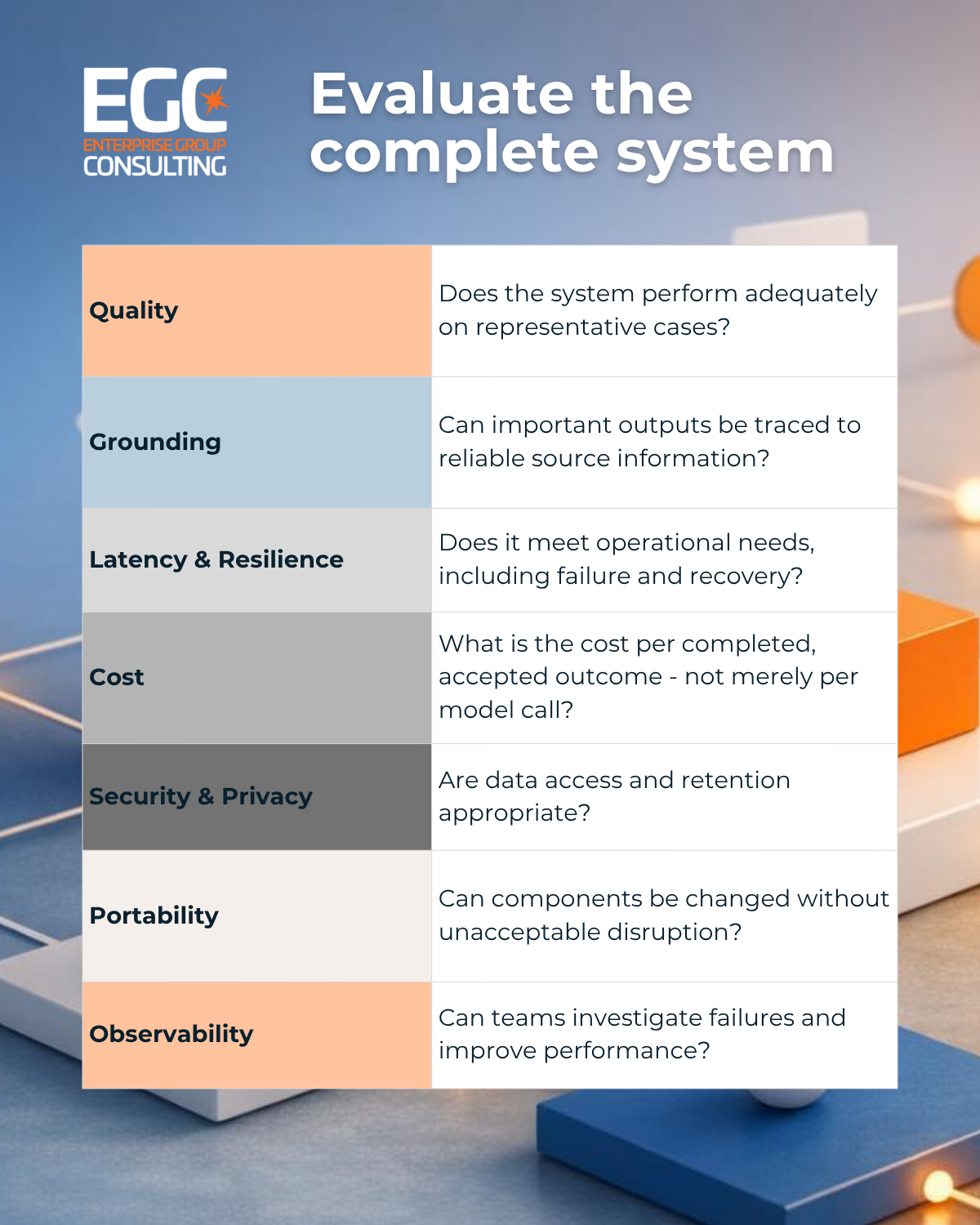


EGC Consulting infographic titled


Strong AI outcomes depend on strong foundations

The architecture conversation also needs to extend beyond models and platforms. AI can make information more accessible, but it cannot reliably compensate for fragmented data ownership, inconsistent definitions, poor-quality source information or inappropriate access permissions.

These underlying issues can undermine even a technically sophisticated solution. If information is incomplete, duplicated or difficult to trust, AI may simply make those problems more visible, or amplify them.


Data quality, infrastructure, integration and governance should therefore be considered part of the AI investment from the outset, rather than treated as problems to resolve once a pilot proves successful.


Balance experimentation with enterprise discipline

There are two extremes organisations need to avoid.


The first is over-engineering a platform before the business problem is properly understood. The second is allowing disconnected AI experiments to multiply without considering duplication, risk, support requirements or the cumulative cost of running them.


A more disciplined portfolio approach creates room for experimentation while establishing common standards for evaluation, integration, security and production readiness.

It allows teams to test different approaches and demonstrate value without creating an increasingly fragmented technology environment.


For executives, this means asking not only whether an AI initiative works, but whether it can be supported, scaled and maintained in a way that makes commercial sense.

The architecture needs to support the value

Closing the AI Value Gap requires more than identifying opportunities to use AI or investing in increasingly capable models. It requires deliberate decisions about where AI belongs, which technology is appropriate, what foundations are needed and how success will be measured.


Architecture and economics cannot be left as technical considerations once the investment decision has been made. They need to be part of the conversation from the beginning. Because ultimately, the value of an AI investment isn't determined by the sophistication of the model. It's determined by the business outcomes the complete solution can deliver.

Share This Article

Recent Articles

Glass-fronted building entrance with metal frame, seen through a warm orange tint, with a small logo in the corner
By Sarah McCandless • October 22, 2026
Discover the five signs your transformation is undergoverned and how stronger governance improves accountability, decision making and value realisation.
August 27, 2026
Moving AI initiatives into production requires specialized, on-demand expertise. Here is how banking leaders are accelerating delivery.
People collaborating over documents at a table in a warm-lit meeting room, with a logo in the corner
By Sarah McCandless • July 27, 2026
Team augmentation provides organisations with specialist project delivery, technology and transformation capability when they need it most.
Two people smiling in a warm-toned office meeting, with a laptop and ELC logo in the corner.
June 5, 2026
High-impact transformation leaders in 2026 are defined by a rare combination of accountability, stakeholder influence, technical depth and end-to-end delivery ownership. This article explores what separates successful transformation leadership from stalled execution, drawing on McKinsey and PwC research.
Man in suit smiles, holding papers, walking in office. Woman in background.
February 1, 2026
When organisations are navigating change, growth or complexity, executive appointments become high-stakes decisions.
Woman in glasses giving a presentation, pointing at a whiteboard, talking to colleagues.
By Sarah McCandless • December 11, 2025
Discover why OKRs are gaining momentum beyond tech and how non-tech industries are using them to build clarity, alignment and measurable impact.
Woman giving a presentation to a seated group. Beige interior with neutral colors.
By Sarah McCandless • October 15, 2025
The 2025 CEW Census reveals progress on gender equity has stalled — with 9 in 10 ASX 300 CEOs still men. Here’s what needs to change.
Group of colleagues looking at a computer screen, smiling and engaged in an office setting.
By Sarah McCandless • August 20, 2025
Scaling digital transformation requires more than technology. Discover strategies to align stakeholders, build sustainable change, and see how Enterprise Group Consulting helps organisations scale with confidence.
By Sarah McCandless • June 11, 2025
Enterprises operate under continuous pressure to drive innovation, scale operations and respond effectively to evolving technologies, market dynamics and regulatory requirements. Successfully managing this complexity demands seasoned, strategic IT leadership—precisely what fractional IT leadership provides. What Is Fractional IT Leadership? Fractional IT leadership refers to experienced CIOs, CTOs and senior IT executives who engage with organisations on a part-time, project-based or interim basis. Unlike traditional full-time hires, fractional leaders provide targeted expertise and strategic guidance aligned with your immediate priorities and long-term goals. This flexible model allows businesses to access top-tier leadership without the full-time overhead. Meeting Market Demands with Agile IT Leadership Technology innovation and digital disruption continue at breakneck speed. Businesses must rapidly pivot IT strategies, embrace cloud migration, enhance cybersecurity and integrate increasingly complex systems. All while managing budgets and talent shortages. Achieving this demands IT leadership that can respond swiftly and decisively, steering transformation initiatives with clarity and confidence. Engaging fractional IT leaders brings a range of strategic advantages: Access to senior expertise: Gain insights from seasoned professionals with diverse industry backgrounds and proven track records. Cost efficiency: Avoid the expense and commitment of full-time executive roles, paying only for the leadership you need. Scalability: Scale leadership involvement up or down as your projects and priorities evolve. Accelerated execution: Drive faster decision-making and execution of critical digital initiatives. Risk mitigation: Leverage expert guidance on governance, security and compliance to reduce operational risks. How Enterprise Group Consulting Supports Fractional Leadership At Enterprise Group Consulting , we provide a curated network of senior IT leaders ready to engage flexibly with your organisation. Whether you need interim leadership to guide a transformation, niche expertise to augment your team, or ongoing part-time CIO support, we tailor our solutions to fit your strategic needs. Our approach ensures seamless collaboration with your internal teams to deliver measurable outcomes. To successfully engage fractional IT leadership, consider these steps: Define clear objectives and the scope of leadership involvement. Establish measurable success criteria to track progress. Ensure cultural and strategic alignment between fractional leaders and your organisation. Plan for integration with existing teams to maximise impact. Ready to explore how fractional IT leadership can transform your IT strategy? Contact us to learn more about our leadership solutions tailored to your business goals.
A group of chess pieces are connected to each other on a table.
By Sarah McCandless • April 29, 2025
At Enterprise Group Consulting (EGC), we know a tough truth: not every project, hire or operational strategy deserves infinite perseverance. Sometimes the smartest move isn't to push harder — it’s to pause, rethink and pivot. The line between persistence and sunk-cost stubbornness can get blurry. Leaders often find themselves asking: Should we keep going? Or is it time to change direction? Projects: Progress vs. Stagnation Every project hits speed bumps. But when challenges turn into chronic roadblocks — missed deadlines, scope creep without end, endless rounds of "re-scoping" — it might not be about effort anymore. It might be about fit.  Signs it’s time to pivot: The original business problem no longer exists (or has shifted) Team engagement has plummeted beyond repair Costs are ballooning with no path to ROI.
Show More

Archive

Glass-fronted building entrance with metal frame, seen through a warm orange tint, with a small logo in the corner
By Sarah McCandless • October 22, 2026
Discover the five signs your transformation is undergoverned and how stronger governance improves accountability, decision making and value realisation.
August 27, 2026
Moving AI initiatives into production requires specialized, on-demand expertise. Here is how banking leaders are accelerating delivery.
People collaborating over documents at a table in a warm-lit meeting room, with a logo in the corner
By Sarah McCandless • July 27, 2026
Team augmentation provides organisations with specialist project delivery, technology and transformation capability when they need it most.
Two people smiling in a warm-toned office meeting, with a laptop and ELC logo in the corner.
June 5, 2026
High-impact transformation leaders in 2026 are defined by a rare combination of accountability, stakeholder influence, technical depth and end-to-end delivery ownership. This article explores what separates successful transformation leadership from stalled execution, drawing on McKinsey and PwC research.
Man in suit smiles, holding papers, walking in office. Woman in background.
February 1, 2026
When organisations are navigating change, growth or complexity, executive appointments become high-stakes decisions.
Woman in glasses giving a presentation, pointing at a whiteboard, talking to colleagues.
By Sarah McCandless • December 11, 2025
Discover why OKRs are gaining momentum beyond tech and how non-tech industries are using them to build clarity, alignment and measurable impact.
Woman giving a presentation to a seated group. Beige interior with neutral colors.
By Sarah McCandless • October 15, 2025
The 2025 CEW Census reveals progress on gender equity has stalled — with 9 in 10 ASX 300 CEOs still men. Here’s what needs to change.
Group of colleagues looking at a computer screen, smiling and engaged in an office setting.
By Sarah McCandless • August 20, 2025
Scaling digital transformation requires more than technology. Discover strategies to align stakeholders, build sustainable change, and see how Enterprise Group Consulting helps organisations scale with confidence.
By Sarah McCandless • June 11, 2025
Enterprises operate under continuous pressure to drive innovation, scale operations and respond effectively to evolving technologies, market dynamics and regulatory requirements. Successfully managing this complexity demands seasoned, strategic IT leadership—precisely what fractional IT leadership provides. What Is Fractional IT Leadership? Fractional IT leadership refers to experienced CIOs, CTOs and senior IT executives who engage with organisations on a part-time, project-based or interim basis. Unlike traditional full-time hires, fractional leaders provide targeted expertise and strategic guidance aligned with your immediate priorities and long-term goals. This flexible model allows businesses to access top-tier leadership without the full-time overhead. Meeting Market Demands with Agile IT Leadership Technology innovation and digital disruption continue at breakneck speed. Businesses must rapidly pivot IT strategies, embrace cloud migration, enhance cybersecurity and integrate increasingly complex systems. All while managing budgets and talent shortages. Achieving this demands IT leadership that can respond swiftly and decisively, steering transformation initiatives with clarity and confidence. Engaging fractional IT leaders brings a range of strategic advantages: Access to senior expertise: Gain insights from seasoned professionals with diverse industry backgrounds and proven track records. Cost efficiency: Avoid the expense and commitment of full-time executive roles, paying only for the leadership you need. Scalability: Scale leadership involvement up or down as your projects and priorities evolve. Accelerated execution: Drive faster decision-making and execution of critical digital initiatives. Risk mitigation: Leverage expert guidance on governance, security and compliance to reduce operational risks. How Enterprise Group Consulting Supports Fractional Leadership At Enterprise Group Consulting , we provide a curated network of senior IT leaders ready to engage flexibly with your organisation. Whether you need interim leadership to guide a transformation, niche expertise to augment your team, or ongoing part-time CIO support, we tailor our solutions to fit your strategic needs. Our approach ensures seamless collaboration with your internal teams to deliver measurable outcomes. To successfully engage fractional IT leadership, consider these steps: Define clear objectives and the scope of leadership involvement. Establish measurable success criteria to track progress. Ensure cultural and strategic alignment between fractional leaders and your organisation. Plan for integration with existing teams to maximise impact. Ready to explore how fractional IT leadership can transform your IT strategy? Contact us to learn more about our leadership solutions tailored to your business goals.
A group of chess pieces are connected to each other on a table.
By Sarah McCandless • April 29, 2025
At Enterprise Group Consulting (EGC), we know a tough truth: not every project, hire or operational strategy deserves infinite perseverance. Sometimes the smartest move isn't to push harder — it’s to pause, rethink and pivot. The line between persistence and sunk-cost stubbornness can get blurry. Leaders often find themselves asking: Should we keep going? Or is it time to change direction? Projects: Progress vs. Stagnation Every project hits speed bumps. But when challenges turn into chronic roadblocks — missed deadlines, scope creep without end, endless rounds of "re-scoping" — it might not be about effort anymore. It might be about fit.  Signs it’s time to pivot: The original business problem no longer exists (or has shifted) Team engagement has plummeted beyond repair Costs are ballooning with no path to ROI.